

SkyFleet: Can We Trust the Autonomous Sky?
Suprim Karki Bijaya Rokka, Prabin Khatri , Purnaman Rai , Shlok Prasad Joshi, Suprim Karki
Introduction
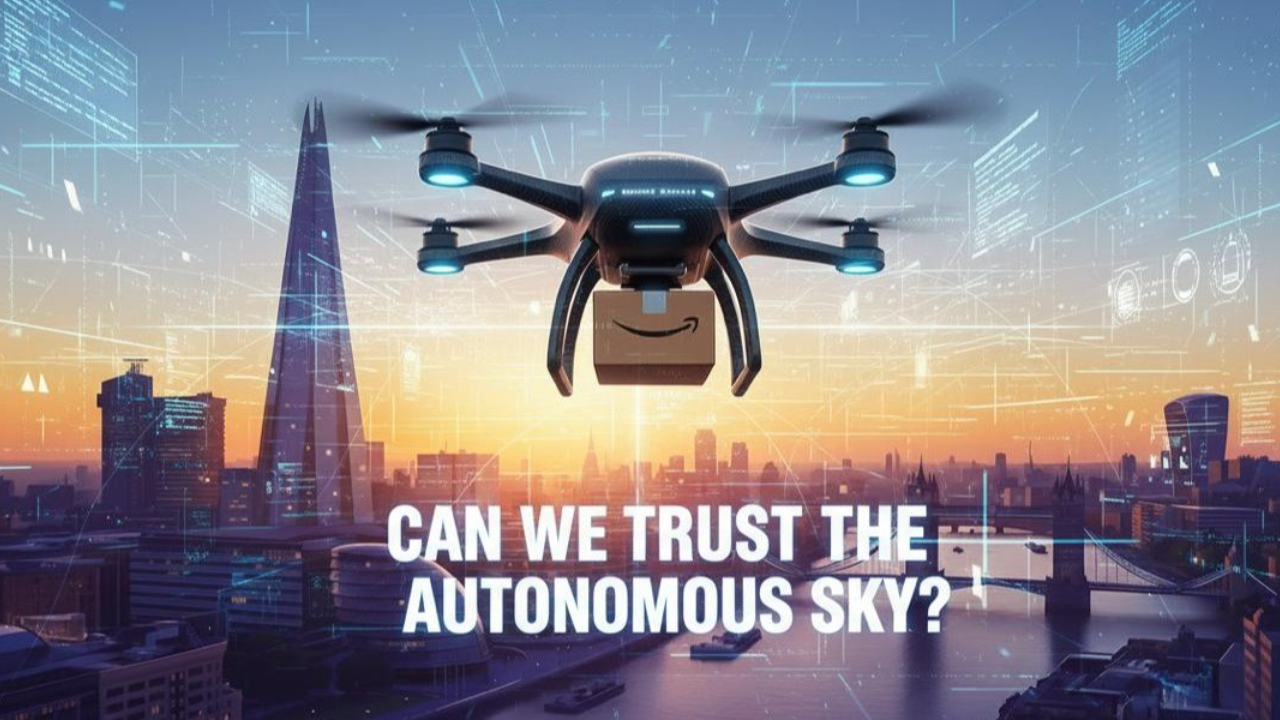
Imagine looking up at the London skyline and seeing not just birds, but a swarm of 500 autonomous drones. For SkyFleet, this is not a science-fiction idea, but it is an everyday operation making 15,000 deliveries to retail giants such as Amazon and Tesco. Although the idea of a sustainable last-mile delivery that will lower the vans emission by 60% appears to be a win to both the environment and the consumer, the truth on the ground, or in the air, is much more complicated. But there are a set of severe ethical issues concealed behind the advanced technology of Edge Computing and Computer Vision. Whether it is the crashing of drones on pedestrians or the socio-economic displacement of thousands of employees, the practical reality of SkyFleet is that, is this innovation being handled with proper responsibility or is this organisation focusing on market supremacy over the lives of people? This collaborative paper analyses SkyFleet ecosystem in the critical perspectives of research and development, professional responsibility, cybersecurity, social inequality, and governance.
Research & Development
From an engineering perspective, Skyfleet can be considered a masterpiece in the modern era of computer science. It incorporates three powerful technologies: Autonomous Systems, Computer Vision and Edge Computing. Unlike all the other drones that are remotely controlled, Skyfleet drones use Edge Computing to process high-definition sensor feeds. This architecture is crucial to the functioning of a city as using a central cloud server creates a latency that could be disastrous in a congested city since a drone might not be able to respond quickly to the crash (Rancea et al. 2024). In order to reduce this risk, edge computing allows drones to navigate changing conditions.
The global trend towards autonomous deliveries is undeniable, but its implementation must be highly contextualised to geographical settings. For instance, although it is true that organisations such as Nepal Flying Labs are currently testing drone deliveries for critical medicine in low-density regions such as Humla (Nepal Flying Labs, 2022), SkyFleet's ambitions are vastly more aggressive. The high-pressure environment in which they are operating, 500 drones to deliver 15,000 deliveries a day, means that technological failure is statistically inevitable. Let us suppose that if a system has even a 1% error rate, which potentially equates to 150 "risky" deliveries a day. Furthermore, although current obstacle avoidance systems would indeed be effective in highly structured high-rise cities such as Birmingham, they would likely be ineffective in chaotic streets of Kathmandu.
The primary hook behind the explosive expansion of SkyFleet is the fact that the company is dedicated to being sustainable, namely, its promise to provide a 60 percent cut in last-mile tailpipe emissions by substituting heavy vans with drones. With the industry shifting towards the idea of Green IT, this story turns so tempting to corporate partners who are environmentally conscious about environmental sustainability. However, this claim demands very close technical analysis. Recent studies indicate that although carbon emissions are reduced in the short term, the enormous amount of energy required to produce lithium-based drones to run Edge Computing processing offsets this environmental benefit (Rancea et al. 2025).
To be considered a fully responsible innovation, SkyFleet must show that the carbon reduction that it will achieve does not simply push the energy load out of the street and onto the data centre. Moreover, the engineers have to focus on the creation of hardware that remains highly computational without depending on the manufacturing process, which is resource-consuming and undermines the long-term ecological benefits. As developers we must champion the idea of no longer being on a continuum of fail fast commercial ethos but rather the idea of resilient autonomy where systems are carefully tested to be sustainable and aligned with localised environmental conditions before they are put in the public airspace (IEEE 2024).
Responsible Al & Ethics
A technical system failure in a controlled laboratory is considered a valuable data point. However, a failure in public airspace resulting in physical damage is a serious breach of professional responsibility. In the case of SkyFleet, there is a massive compliance gap with the British Computer Society (BCS) Code of Conduct. The central pillar of this professional framework is the "Public Interest," according to which IT professionals are specifically required to prioritise the interests of people in the realms of health, privacy, and safety. The track record of SkyFleet is a serious violation of this principle, as it has already documented a two-kilogram package falling on a child and a drone hitting a cyclist. These cases prove that the victims of algorithmic errors are real, and that one cannot ignore such errors as glitches.
The BCS Code, namely the section on Professional Competence and Integrity, places a heavy responsibility on developers to ensure that their products are fit for purpose (BCS, 2022). The fact that the drone's Computer Vision model cannot distinguish between a designated landing pad and a child's backpack demonstrates that the technology is not yet ready for commercial use. This incident raises an important ethical question about whether the AI was truly ready to operate or whether it was released too early under investor pressure to gain a competitive advantage. Researchers caution that implementing AI prematurely, before fully comprehending its nature, would imply that its imperfections would be tested not in a laboratory but in the real world (Radanliev & Santos, 2023). Practically, this rush-to-growth culture transfers the physical risk to the people.
This contradiction between speed and safety is a global problem. The same applies to the fintech industries in Nepal, where many are in a hurry to release applications without fully auditing their security and safety (IFC, 2025). Another point mentioned in the BCS Code is that developers have a duty, as part of their duty to the profession, to speak out about the risks they identify, even when remaining silent could appear more protective of their careers. Aviation regulators also emphasise that the active involvement of the population in the introduction of new aerial technologies is necessary. Unless people feel that drones are safe and well-regulated, the industry will lose public trust and be unable to continue operating (Hynek et al., 2025). Therefore, the transparency and visible safety precautions are the only means of ensuring trust.
To correct such systemic failures, SkyFleet will need to undertake strict safety measures immediately. This requires mandatory, independent third-party audits of all AI deployment and risk-assessment frameworks to ensure strict compliance with aviation-level safety standards. In fact, recent AI safety studies propose precisely this type of external validation, identifying frontier AI auditing as an independent third-party assessment of safety claims and practises of developers (Brundage et al., 2026). The management should enable engineers to stop deployments when the safety metrics are at risk and prioritise the safety of the population over short-term business objectives. In short, SkyFleet must embed the public interest into its product lifecycle, ensuring accountability and safety before scaling commercial use.
Cybersecurity & Privacy
Even though SkyFleet’s drones are termed as technical achievements, they primarily operate as high-altitude, mobile surveillance programs. These drones use high resolution cameras and LiDAR sensors for navigation purposes in urban environments, while recording every detail of the surroundings captured by the cameras. However, storing raw sensory footage for 90 days to train the AI models raises ethical and legal concerns violating the BCS Code of Conduct: Public Interest (BCS, 2022). For a resident in London or Birmingham, this means video of their private properties can be recorded and stored for three months on a server. Due to this, Right to Privacy and UK GDPR standards will be at fault, shifting the issue from technical necessity to potential intrusive surveillance (Information Commissioner’s Office, 2025). Similarly, in Nepal’s context, if Skyfleets’ drone system is built with the same 90 days policy, it would threaten the fundamental right to "privacy of residence" protected under Article 28 of the Constitution and the Privacy Act, 2018 (OnlineKhabar, 2025).
With the use of SkyFleet’s autonomous drone system, the risk is not just theoretical, it is operational as well. The gravity of risks was realized when 12 SkyFleet drones were successfully hijacked by hackers gaining access to on-board data streams where the packages were redirected to the wrong addresses. One of these intercepted deliveries contained a medical prescription, exposing extremely sensitive health information to unauthorized parties. This incident demonstrated that when security and privacy are treated as secondary concerns, there is a high chance of security breach. Due to these incidents, BCS Code of Conduct, particularly Public Interest and Professional Competence and Integrity, are violated (BCS, 2022). In the context of Nepal, these breaches are extremely sensitive since Digital Nepal Framework (MoCIT, 2019) is still developing. To address this, the government has made a draft on Digital Nepal Framework 2.0 (MoCIT, 2025), which focuses on strengthening data protection and promoting ethical AI use. Nevertheless, when compared to European countries, our current legal protection against aerial surveillance is still in the early stages causing vulnerability.
To mitigate such intrusions or data breach, developers must prioritize “Privacy by Design” framework rather than trying to solve the privacy issues after the system is already deployed in the market. One of the biggest problems SkyFleet faces is that it is overly centralized. To prevent the risk of centralized data leaks, implementation of Edge-Based Automated Anonymization is vital as it helps the drone system to immediately anonymize or blur non-essential data like people’s faces and private properties before the data is stored to a central server instead of transmitting and storing the raw footage (AAI-Drones, 2026).
To ensure data privacy while training AI models, drone systems must be designed by using and storing only simple basic shapes and outlines rather than saving actual video footage. According to the European Data Protection Board (2023), we must recognize that in a digital age, if the drone systems continuously monitor the citizens, then the development of the technology that is built to serve will ultimately be rejected by society because a breach of privacy is a breach of public trust.
Social Impact
The automation idea is presented often as a sign of progress. Several discussions focus on efficiency and how technology makes services quicker and affordable. However, efficiency is not always entirely positive. In SkyFleet's case, the use of delivery drones by the company has replaced about 2300 delivery drivers. These are real individuals who to support their families relied on these jobs. When machines replace workers in such scale, it becomes important to see beyond technological advancement and consider its social impact.
This condition also raises questions about the responsibilities of those in the technology sector. The BCS principle highlights that technology should be serving the public interest and contributing to society. If automation is helping companies for cost reduction while several workers lose their jobs, it is difficult to believe that it is really benefiting society. Research concludes that automation and AI often disturb labour markets, particularly affecting jobs with low skill requirements(World Economic Forum, 2023). SkyFleet shows that innovation without considering social consequences will create concerns about ethics.
Another issue is unequal access to these services, sometimes referred to as digital redlining. The service currently focuses on rich areas while poorer communities receive late service or sometimes even none. Limitations in technology also play a role, as drones struggle to reach high-rise buildings, which are common in cities such as London. This is neglecting several individuals while they might still be experiencing negative effects of drones such as noises or privacy breaches. Studies also show that digital infrastructure and algorithms bias can reinforce social inequality unintentionally (OECD, 2021).
Looking at Nepal, the potential results are even clear. Several cities heavily rely on gig workers and delivery riders who keep daily services running. These workers are part of not only a business model but local economy. If autonomous delivery, just for profit, replaces them, it could create significant economic challenges, especially where there are limited social safety nets. Research on developing economies shows the importance of automation management to avoid leaving behind workers (International Labour Organization, 2019).
To address these risks, measures should be introduced to protect workers and guarantee fairness. One solution is a Social Impact Levy on companies using these autonomous delivery systems. Part of the savings from reduced labour costs could fund retraining programmes, helping displaced workers to transition into technical or maintenance roles in the logistics sector (World Economic Forum, 2020). Regulators should also require that companies provide services across all neighbourhoods not on just the wealthiest areas. Technology should rather than widening gaps between those who can access innovation and those who cannot, advance society as a whole.
Governance & Accountability
Even though the autonomous network of SkyFleet can be taken as a giant step in the field of logistics, it has also unveiled a serious necessity to do something better in terms of managing the airspace. Such an unprecedented level of innovation cannot be achieved without a regulatory system to support it. Which is why the current system seems to be struggling to accommodate the 15,000 daily flights. An example of this is the 2024 incident with the Wiltshire Air Ambulance, where they nearly collided with a drone during a high-stakes emergency (Wiltshire Air Ambulance, 2024). This type of unregulated innovation directly violates the BCS Code of Conduct with respect to the Public Interest, specifically the professional obligation to protect health by addressing any potential threats.
However, a critical analysis of the standards from different countries reveals the formulation of better precautionary models . We can use the example of the Civil Aviation Authority of Nepal (CAAN) that suggested a more powerful precautionary model in 2026. Unlike the UK's initially relaxed approach to the implementation of the system, CAAN requires the registration of all logistics operations above 25kg at the municipality level. This is a critical addition that SkyFleet failed to provide.
To remain professionally competent, SkyFleet needs to shift to an integrated Unmanned Traffic Management (UTM) system rather than be the one that operates in obstacle avoidance. Which should be given priority access to emergency helicopters via real time data sharing, shift to isolated autonomy to collaborative governance.
Leaving the aspect of safety, the so-called Green story which serves as the primary marketing point of SkyFleet should be analysed. Though the 60 percent decrease in van emissions is significant, the problem of the Lithium paradox is not discussed. Every 500 drones are powered by high-density lithium-cobalt batteries with a limited lifecycle. If this issue is not addressed by 2026, research has indicated that recycled lithium will only be able to provide 30% of the world's demand, resulting in the continuous need for 'virgin minerals' (Farmonaut, 2026). The 2025 research on the cobalt supply chain once again indicates a high prevalence of forced labour and the use of children in artisan mines (University of Nottingham, 2025).
As a computing professional, it cannot suffice to be ethical if we focus only on hardware rather than on environmental degradation. My recommendation is to make the transition to a "Closed Loop" Asset Governance model a requirement. SkyFleet will need to switch to hydrometallurgical recycling that would retrieve up to 98% of lithium, unlike the old-fashioned fire-based methods (HereWin Power, 2026). Sustainability is not only concerned with the emission in London but also the lifecycle of the code and hardware. The real professional responsibility is to audit the whole digital and physical footprint of our innovations to avoid the situation when the green solutions cover deeper ecological and humanitarian disasters.
Conclusion
SkyFleet is an excellent example of the conflict between the fast growth of technology and professionalism. While the projects succeed from a technical standpoint, it fails to completely work for society and people because of issues with privacy, social impact and governance. To transfer something from just a ‘last-mile dream’ to community-based service, it needs more than just better Python scripts or faster Edge Computing. The developers must follow the BCS Code of Conduct to make this transition. They must follow and commit to the principles of public interest, professional competence, and duty to the profession. In the end, the success of drone delivery depends on a system rather than itself. It depends on a secure encryption system, strict air traffic rules and ethical mineral sourcing used to build the technology. With the advent of automated logistics, the point at which we will consider innovation a success will not be the fact that we can fly more quickly, but rather the professional bravery to say wait when safety, equity, and ethics are in jeopardy.
This research report has been prepared by students of The Westminster College, Kupandole, as part of their module requirements. Students are required to write a research paper and publish it on their LinkedIn profiles.